Institute of Molecular Genetics of the Czech Academy of Sciences
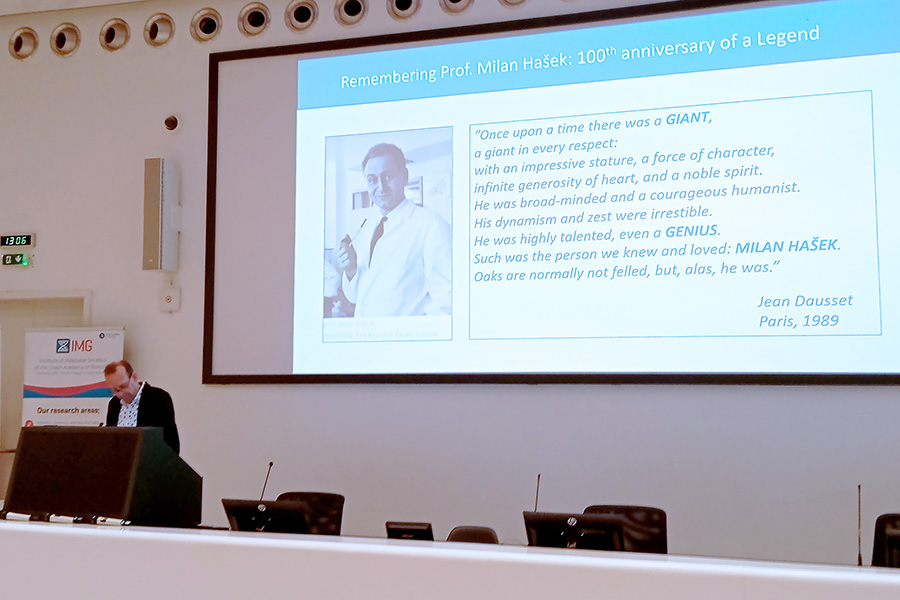
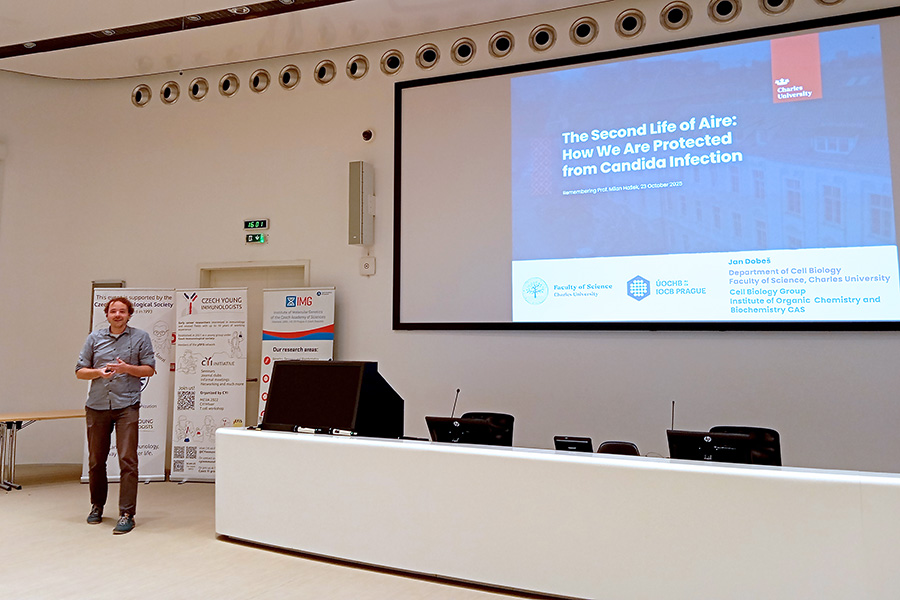
Prague, 23 October 2025 – A mini-conference dedicated to the 100th anniversary of the birth of Prof. Milan Hašek (1925–1984), one of the most prominent Czech biologists and a co-discoverer of the phenomenon of immunological tolerance, took place in the Milan Hašek Auditorium of the Institute of Molecular Genetics of the Czech Academy of Sciences. The event was organized by the Institute of Molecular Genetics of the Czech Academy of Sciences (IMG) in cooperation with the Czech Immunological Society.
The event was attended by leading Czech and international immunologists, who reflected not only on Prof. Hašek’s life and scientific achievements but also on recent developments in immunoregulation, transplantation, and autoimmune processes. The participants were welcomed by short opening remarks from Dr. Petr Dráber (director of IMG) and Dr. Luca Ernesto Vannucci (president of the Czech Immunological Society). Among the invited speakers were Prof. Juraj Ivanyi (King’s College London), Prof. Vladimír Holáň, Dr. Jiří Hejnar, Dr. Ondřej Štěpánek, Dr. Jan Dobeš, Dr. Matouš Vobořil, and Dr. Jiří Březina. All speakers emphasized the extraordinary influence of Hašek’s school on the development of modern immunology and on the training of an entire generation of scientists active today both in the Czech Republic and abroad.
Prof. Milan Hašek was an exceptional figure in Czech science. His experiments in the early 1950s made a fundamental contribution to understanding that the immune system can learn to tolerate foreign cells if it encounters them during early development. In his research, he used an original method known as embryonic parabiosis, in which the circulatory systems of avian embryos were joined. He found that chicks connected during development did not produce antibodies against the red blood cells of their “partner,” and their tissues did not reject each other after hatching.
This phenomenon was independently described, using a laboratory mouse model, by the British team led by P. B. Medawar. The discovery of immunological tolerance marked a major breakthrough in immunology and became one of the cornerstones of modern transplant medicine.
Immunological tolerance represents a state in which the immune system does not react to a specific antigen, even though it would normally trigger an immune response. It can arise naturally during organismal development (so-called central tolerance) or be induced experimentally. During the second half of the 20th century, it became clear that this phenomenon could be mediated by various mechanisms — from clonal elimination and lymphocyte anergy to the action of suppressor cells. Understanding these processes contributed not only to the advancement of transplantation medicine but also to a better understanding of autoimmune and allergic diseases.
Participants of the mini-conference agreed that Milan Hašek’s legacy, scientific courage, and originality of thought continue to inspire today’s generation of immunologists. His work demonstrates that even under challenging conditions, discoveries of global significance can emerge.
Milan Hašek – Reminder of a Man