Institute of Molecular Genetics of the Czech Academy of Sciences
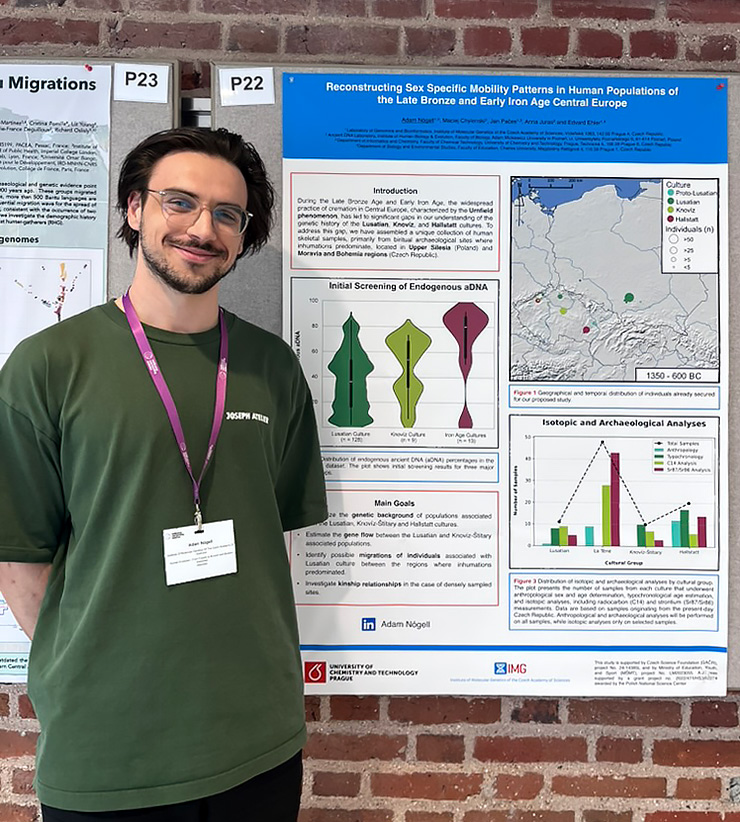
How can DNA that is thousands of years old be used to reconstruct the movements of ancient populations? In an interview, PhD student Adam Nógell from the Laboratory of Genomics and Bioinformatics at the IMG talks about his research on migrations at the end of the Bronze Age, his motivation for pursuing a PhD, and how he manages to maintain a balance between science and personal life.
What led you to decide to pursue a PhD at IMG, and when did you make this decision?
I have been thinking about a PhD since the beginning of my studies at the university. During the studies, my plans have changed several times, and the final decision came at the end of my master’s studies. There, I had an opportunity to encounter bioinformatics, which got me interested up to the point that I decided to continue studying this field as my PhD project.
What is your current research focus, and what makes this field particulary exciting or unique in your view?
The main focus of my PhD thesis is to reconstruct the migration pathways of people during the Bronze Age in Central Europe by analysing the DNA extracted from their bones. I find particularly fascinating the amount of information that can be found “just” by analysing DNA, especially in this case, a DNA that is more than 4000 years old. Additionally, this is a field that is studied by relatively few researchers, which makes me grateful that I can be a part of it.
“I find particularly fascinating the amount of information that can be found ‘just’ by analysing DNA, especially in this case, a DNA that is more than 4000 years old.”
What does you life look like outside the lab/work, and how do you manage to maintain a healthy work-life balance?
I’m actively trying to exercise regularly, currently this involves mostly indoor climbing (bouldering), but an important part of my personal life is definitely art in almost any form – music, film, theatre… These are activities during which I automatically “switch off,” which helps me maintain this balance.
What are your future academic or professional plans after completing your PhD?
As I was saying earlier, my plans tend to change rather frequently, but recently, I’m getting increasingly fascinated by the start-up world. It would be nice to have my own one day, but I realise that there is still a long way to go.
“The thing I love the most is that there is always something happening here. The number of events, cultural activities and leisure opportunities makes it much easier to keep the work-life balance.”
What do you enjoy most about living in Prague, and where would you take someone who is visiting the city for the first time?
The thing I love the most is that there is always something happening here. The number of events, cultural activities and leisure opportunities makes it much easier to keep the work-life balance. If someone was visiting Prague for the first time, I would surely take them for a walk to see each of the most important landmarks and then we’d visit one of my favourite hidden cafés that ordinary tourists don’t easily discover.
What truly motivates you in your scientific work and keeps you going during challenging periods?
I always remind myself of the reason I enrolled in the PhD programme and especially that I decided so with knowing full well that it’s not going to be easy all the time. I’m working on a topic that I truly enjoy, which makes it much easier to keep going during hard times.
What has been the biggest challenge of your PhD journey so far, and what helped you overcome it?
I’d say that I’m still undergoing the biggest challenge of my PhD. Given that my previous education mainly involved molecular biology, I spent the first few months of my PhD learning a huge amount of new things, as I only encountered bioinformatics in the final year of my master’s degree. I have completed the first year of my PhD, and even though I still have a long way to go, I can see enormous progress over the past year. This is currently a strong motivation for me to continue improving.
What advice would you give to students who are considering applying for a PhD at IMG?
Don’t take the decision to pursue a PhD, or later the choice of a specific topic and research group, lightly. If you decide to enrol into a PhD programme, it will be your focus for the next four years, and more importantly, four years in a very significant phase of your life. Take the time to have constructive conversations with potential future supervisors, colleagues, and other PhD students, and ask them everything you want to know so that you can enter your doctoral studies with realistic and (at least somewhat) clear expectations.
No data.