Institute of Molecular Genetics of the Czech Academy of Sciences
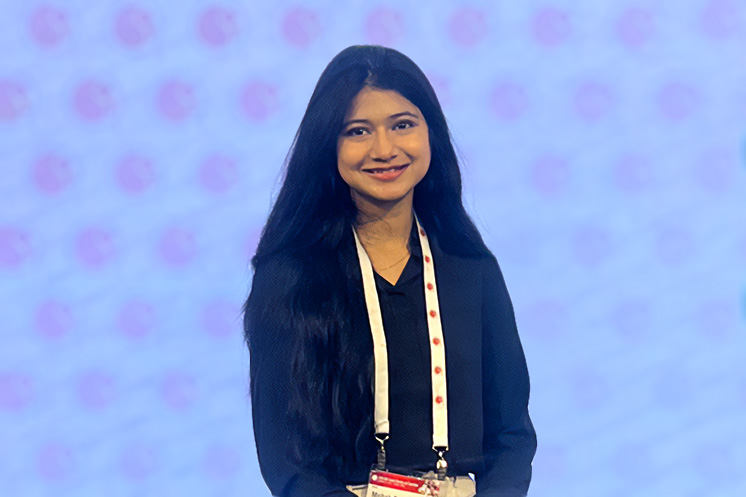
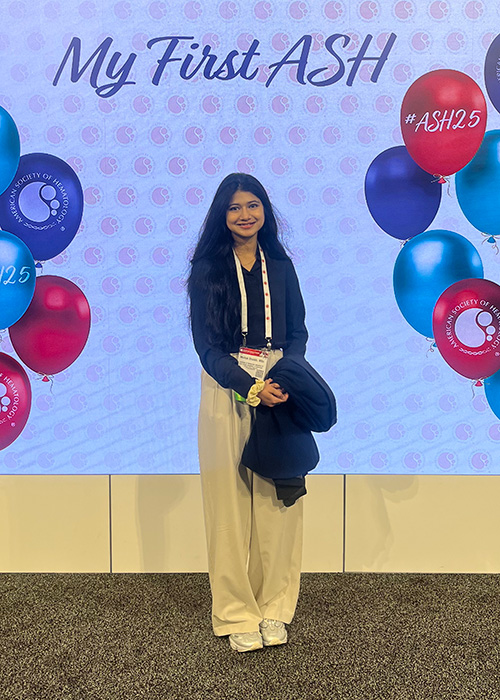
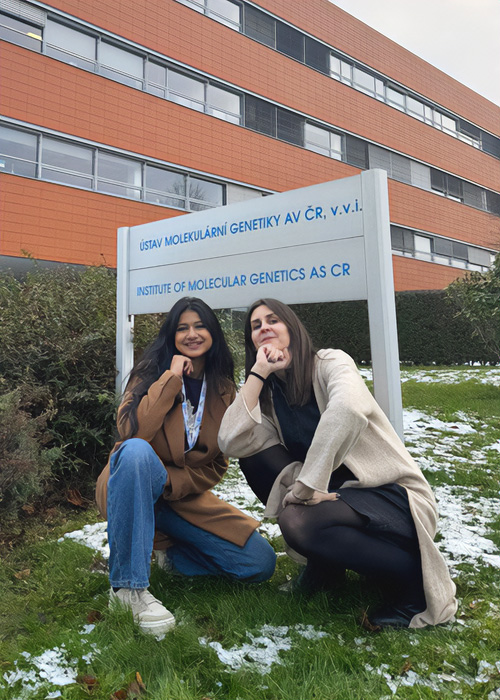
How do blood cancers develop, and how can experimental models help uncover the mechanisms behind them? In an interview, PhD student Mehak Nihal Shaikh shares her journey to the Institute of Molecular Genetics of the Czech Academy of Sciences (IMG) and her research on the role of the enzyme aldehyde dehydrogenase in acute myeloid leukemia (AML). She also talks about her plans after completing her PhD and what makes Prague feel like her second home.
What led you to decide to pursue a PhD at IMG, and when did you make this decision?
After completing my master’s degree in Biological Sciences, I was working as an Editorial Assistant at the Journal of Visualized Experiments (JoVE), and a part of my job was to read a LOT of papers EVERYDAY. One day when I was screening papers for a particular keyword, I came across my current supervisor’s (Meritxell Alberich Jordà) publication, and then I sent her an email. We then connected on Zoom, and she told me about the facilities at IMG and the international environment. I then met the lab, and everything aligned well. That is when I decided to pursue a PhD at IMG.
What is your current research focus, and what makes this field particularly exciting or unique in your view?
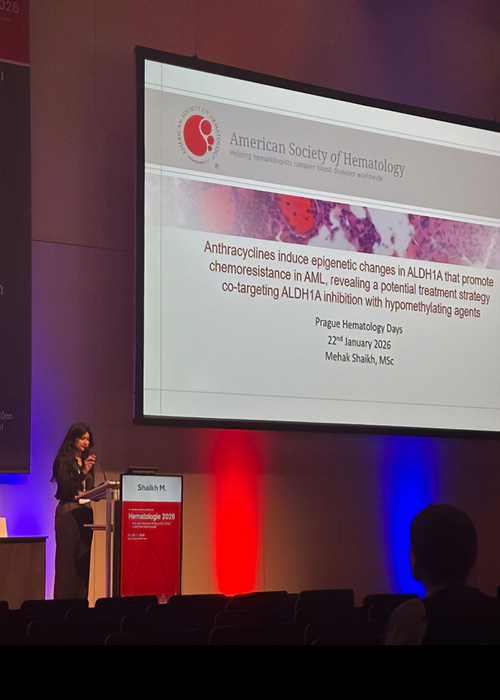
My current research focus is on the role of the enzyme aldehyde dehydrogenase in acute myeloid leukemia (AML). For me, studying AML with mouse models is exciting. When it comes to murine leukemia, I love to see the GFP+ population growing in the mouse, and when it comes to PDX models, I like the uncertainty of the experiment, because you never know if the patient samples will engraft or not :D
What does your life look like outside the lab, and how do you manage to maintain a healthy work–life balance?
My life outside the lab involves Facetiming my mum and sister a LOT. Other than this, I really enjoy cooking, and I am also learning Belly dancing professionally (going to graduate from dance school soon). I try not to open my work at home, to maintain a healthy work-life balance, but I am still a work in progress :)
“My biggest challenge was the transition from a naïve no wet-lab experience student to an independent researcher.“
What are your future academic or professional plans after completing your PhD?
My future definitely involves pursuing a postdoc in either hematology or solid tumor research. For now, my research work does not involve microscopy. So, I am looking forward to a postdoctoral position where I can learn a bit of microscopy, and then I can develop cool images.
What do you enjoy most about living in Prague, and where would you take someone who is visiting the city for the first time?
I love everything about Prague in general. It is my second home. I really enjoy the coffee shops in this city. I love the traditional Czech blueberry dumplings. I would take someone to eat blueberry dumplings and to one of my favorite coffee shops.
“In our lab, we try to help each other when we have big experiments, so working together as a team is another motivation to keep going during challenging periods.“
What truly motivates you in your scientific work and keeps you going during challenging periods?
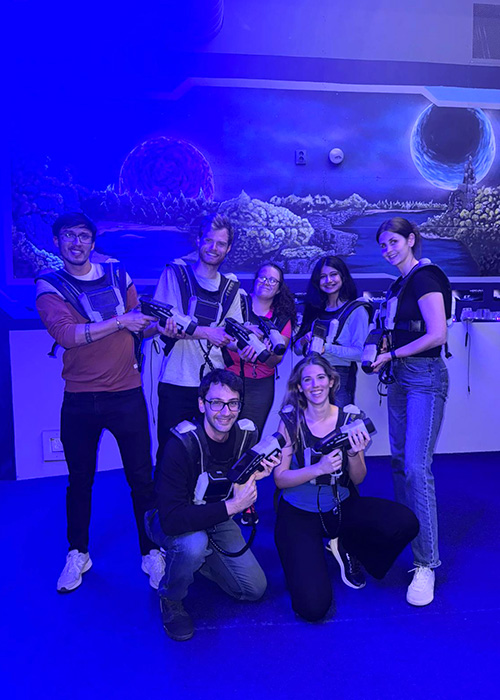
My mum is a big-time positive push in my life; she always pushes me to not give up when things go south. Other than her, my supervisor Meri and my amazing lab colleagues are also a great help during the challenging periods. In our lab, we try to help each other when we have big experiments, so working together as a team is another motivation to keep going during challenging periods. Recently as lab, we started to play laser-tag and killing your colleagues with guns keeps you motivated during tough times hahhaha.
What has been the biggest challenge of your PhD journey so far, and what helped you overcome it?
My biggest challenge was the transition from a naïve no wet-lab experience student to an independent researcher. Believe in yourself that you have the confidence, that you will fail sometimes while putting up an experiment, but then eventually succeed, but the key is to go out and try, this belief really helps in the transition.
What advice would you give to students who are considering applying for a PhD at IMG?
I would advise the students to reach out to the potential supervisors early, and as we are big PhD student community- they should reach out to us and talk to us if they have any queries. And they should take advantage of the collaborative environment at IMG, it really helps to talk to people across groups before applying even when your topic of interest does not match, because sometimes you talk to the supervisor and automatically get interested in the topic and everything aligns from there.
No data.