
Institute of Molecular Genetics of the Czech Academy of Sciences
Why do some patients with an inherited Bardet-Biedl Syndrom lose their vision, develop obesity, or suffer kidney damage early in life, while others experience only mild symptoms? Researchers at the Institute of Molecular Genetics of the Czech Academy of Sciences set out to answer this question. In a new study, Martina Huranová and her team discovered that different mutations in the same gene can disrupt cellular processes in fundamentally different ways—and that these differences may determine the severity of the disease.
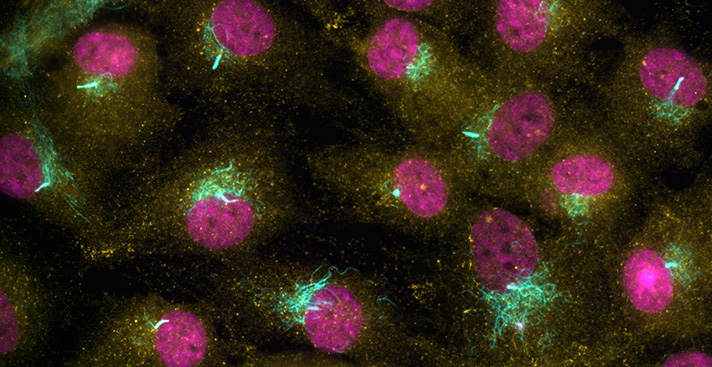
The research focused on Bardet–Biedl syndrome, a rare genetic disorder that affects so-called primary cilia—microscopic projections found on the surface of cells. Although nearly invisible, these structures serve as important communication hubs that allow cells to sense their environment and respond to signals from the body. When cilia fail to function properly, patients may develop vision impairment, obesity, kidney disease, limb abnormalities, or reproductive disorders.
“Patients carrying the same diagnosis often show remarkably different symptoms. We wanted to understand how specific genetic changes affect cellular function and why they lead to different levels of disease severity,” says Martina Huranová, head of the Laboratory of Cilia Genetics and Pathophysiology at the Institute of Molecular Genetics and corresponding author of the study.
The researchers focused on BBS1, the gene most frequently mutated in patients with Bardet–Biedl syndrome. BBS1 encodes a component of a protein complex known as the BBSome, which functions as a cellular transport system responsible for moving essential molecules into and out of cilia.
When this transport system fails, cells lose the ability to properly regulate a range of signalling pathways. The consequences can affect multiple organs simultaneously.
The team analysed three different BBS1 mutations associated with varying degrees of disease severity. They found that each mutation disrupts cellular transport through a distinct mechanism.
One mutation prevents the transport complex from assembling at the earliest stage of its formation. A second allows the complex to assemble but prevents it from reaching the location where it is needed. The third is even more subtle: the complex forms and reaches the cilium, yet it fails to transport its cargo correctly.
“We found that mutations cannot be evaluated solely based on whether a gene is damaged. Equally important is which specific step of a cellular process they disrupt. That may ultimately determine the severity of clinical symptoms,” Huranová explains.
The results revealed that not all mutations have the same biological impact. Some lead to an almost complete failure of the ciliary transport machinery, whereas others affect only a single specific function.
This may explain why some patients develop the full clinical spectrum of Bardet–Biedl syndrome, while others exhibit only isolated symptoms, such as retinal degeneration.
The newly identified mechanisms also make it possible to classify BBS1 mutations into functional categories according to how they disrupt the cellular transport system. Such classification could help physicians better predict disease progression and interpret genetic findings more accurately in the future.
The study provides new insights into the biology of primary cilia and demonstrates that similar genetic diagnoses may arise from distinct molecular mechanisms.
“Understanding the consequences of individual mutations is important not only for basic research but also for the future development of targeted therapeutic approaches. If we know which step of a cellular process is affected, we can more effectively search for ways to restore it,” says Huranová.
The findings represent another step toward personalized medicine, where clinical decisions will increasingly be guided not only by the name of a diagnosis, but also by the precise molecular mechanism underlying the disease.
This research was published in the prestigious international journal Cell Communication and Signaling, which ranks in the top quartile (Q1) in the field of cell biology.
Maskova K, Hajsmanova H, Bykova S, Smite S, Prasai A, Rozbesky D, Huranova M: Bardet-Biedl syndrome 1 mutations differentially impact BBSome integrity and ciliary trafficking. Cell Commun Signal 2026 24(1):462. [pubmed] [doi]