Institute of Molecular Genetics of the Czech Academy of Sciences
Ten years ago, on 16 June 2016, BIOCEV, the Biotechnology and Biomedicine Centre in Vestec near Prague, was officially inaugurated. Over the past decade, this joint project of the Czech Academy of Sciences and Charles University has developed into one of the leading centres of biomedical and biotechnological research in the Czech Republic. Today, BIOCEV is home to more than 600 scientists, technical specialists, and students, nearly one-third of whom have come from abroad. For the Institute of Molecular Genetics of the Czech Academy of Sciences (IMG), the anniversary of BIOCEV provides an opportunity to reflect on the significant role the institute played both in the creation of the centre and in its subsequent development.
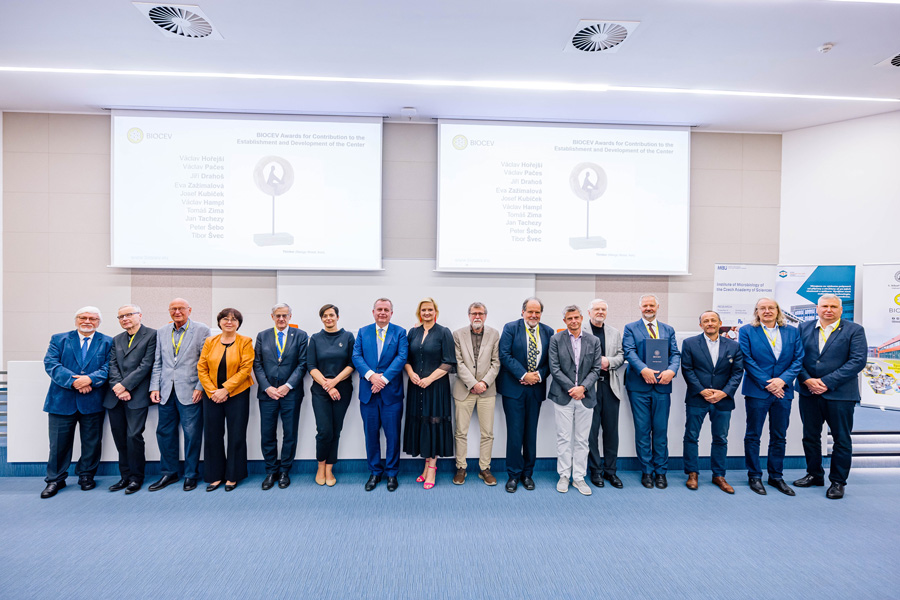
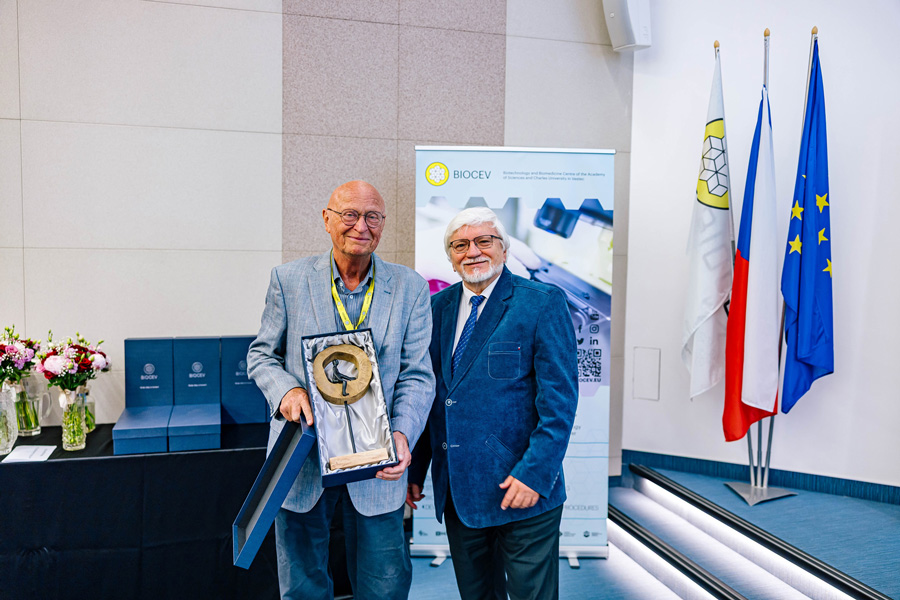
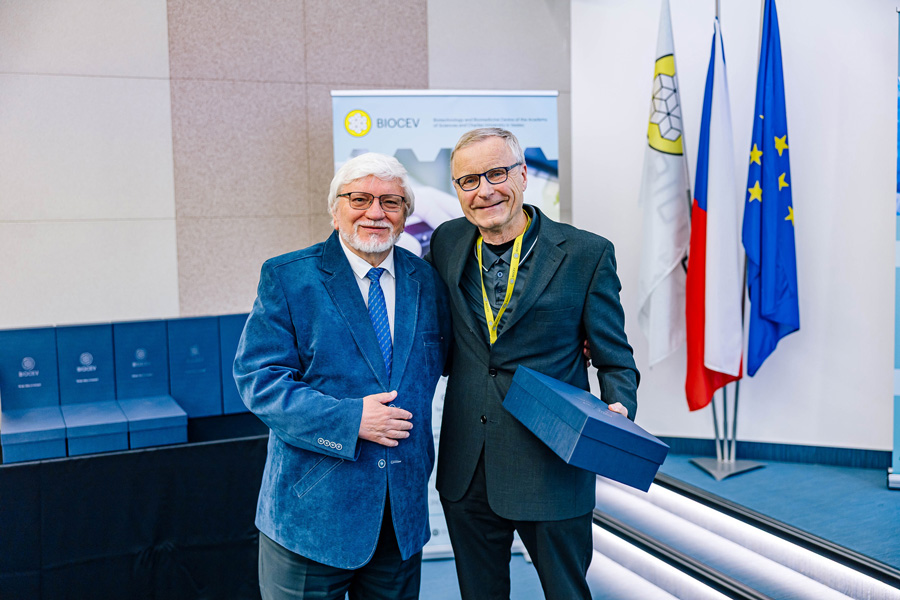
Among the individuals honoured during the anniversary celebration for their contributions to the establishment and growth of BIOCEV were two scientists who have profoundly shaped the history of IMG: Václav Pačes, former President of the Czech Academy of Sciences and former Director of IMG, and Václav Hořejší, former Director of IMG.

“BIOCEV is one of the most important projects in the history of the Institute of Molecular Genetics of the Czech Academy of Sciences. Our scientists were involved from the very beginning, helping to formulate its scientific vision, and today they continue to contribute significantly to its international reputation through the Czech Centre for Phenogenomics and several IMG laboratories based at BIOCEV. Our institute has always sought to be a pioneer and a driving force behind innovation and excellent science—and this remains true today. I am confident that IMG will continue to shape Czech molecular biology and genetics and contribute to scientific discoveries whose impact extends far beyond the borders of the Czech Republic,” says Petr Dráber, Director of the Institute of Molecular Genetics.
From the outset, BIOCEV was an exceptionally ambitious project. Its goal was to create a modern research centre that would bring together biology, medicine, chemistry, and advanced technologies, enabling Czech and international scientists to work in conditions comparable to those at the world’s leading institutions.
Six institutes of the Czech Academy of Sciences joined the project—the Institute of Molecular Genetics, the Institute of Biotechnology, the Institute of Microbiology, the Institute of Physiology, the Institute of Experimental Medicine, and the Institute of Macromolecular Chemistry—together with the Faculty of Science and the First Faculty of Medicine of Charles University. Establishing the centre required not only a clear scientific vision but also the ability to unite diverse research cultures, priorities, and perspectives across numerous institutions and personalities.
“It was not an easy journey. Bringing together so many institutions and people around such an ambitious project was often extremely challenging. That makes it all the more remarkable that we ultimately found common ground and succeeded in building BIOCEV,” recalls Václav Pačes of IMG, one of the project’s principal initiators.
BIOCEV was built with support from the European Union. The grant application itself comprised 1,600 pages, while the construction and equipping of the laboratories required an investment of CZK 2.3 billion. The foundation stone was laid in October 2013, and the centre was officially opened on 16 June 2016.
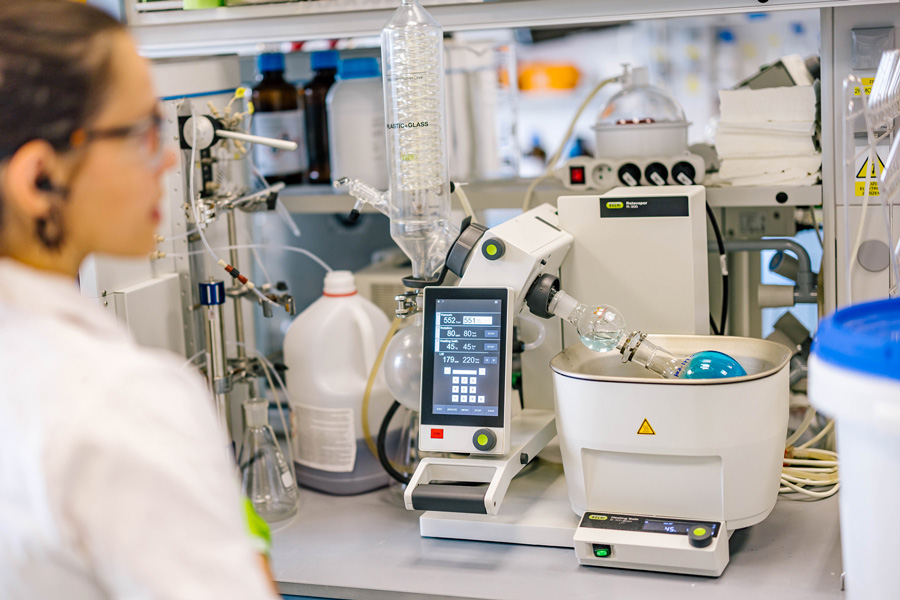
One of the most significant outcomes of IMG’s involvement in the BIOCEV project is the Czech Centre for Phenogenomics (CCP), a major national research infrastructure that has become one of Europe’s leading centres for functional genomics over the past decade. Within BIOCEV, it serves as a key infrastructure for studying gene function, modelling human diseases, and developing new therapeutic approaches.
Under the leadership of Radislav Sedláček, the Czech Centre for Phenogenomics has grown into a world-class research facility. Scientists at CCP generate mouse models of human diseases—so-called “mouse avatars”—that make it possible to study gene function, understand disease mechanisms, and test new treatment strategies before they are applied in patients.
Over the past ten years, the centre has generated more than 1,200 mouse models and investigated more than 600 previously understudied genes. Another major milestone is the RD-Factory programme, which focuses on the development and testing of gene therapies for rare diseases. The centre also operates a unique BSL-3 infectious disease laboratory, where researchers use mouse models to study the biology and treatment of serious infectious diseases, including COVID-19 and viral hepatitis.
Today, the Czech Centre for Phenogenomics bridges basic research and preclinical testing, connecting molecular genetics, experimental medicine, and the development of new therapies. Its achievements demonstrate that investments in cutting-edge infrastructure and a long-term scientific vision can generate discoveries with impact far beyond the Czech Republic.
The importance of BIOCEV and large national research infrastructures became particularly evident during the COVID-19 pandemic. Scientific teams based at BIOCEV, together with researchers from the Academy of Sciences campus of biomedical sciences in Prague-Krč—located just seven kilometres away and serving as the home institutions of many BIOCEV groups—rapidly established and optimized diagnostic capacities based on molecular detection of SARS-CoV-2, participated in sequencing viral variants, and contributed to the development of new therapeutic approaches.
The pandemic demonstrated the importance of having world-class research infrastructures, experts from diverse disciplines, and an environment that enables rapid collaboration across institutions. This was precisely the idea on which BIOCEV was founded.
Teams from Charles University and institutes of the Czech Academy of Sciences, including IMG, joined forces to address the crisis. Research capacities across numerous laboratories contributed not only to testing and diagnostics but also to the development of disease models for evaluating new treatments against infectious diseases.
Today, BIOCEV is more than a leading scientific centre. It also plays an important role in shaping the municipality of Vestec and the wider Central Bohemian Region. It attracts highly qualified professionals from the Czech Republic and abroad, creates employment opportunities, strengthens the region’s knowledge-based and innovation-driven economy, and promotes collaboration between academic research and practical applications.
During the celebrations marking the centre’s tenth anniversary, Tibor Švec, Mayor of Vestec, emphasized that BIOCEV has become an integral part of the municipality’s identity. Thanks to the centre, what was once a village on the outskirts of Prague has become a place associated with cutting-edge science, modern technologies, and international research.
This regional dimension demonstrates that investments in science generate more than scientific publications and new knowledge. They also contribute to regional development, support the growth of the knowledge economy, and help educate future generations of highly skilled professionals.
Over the past decade, with strong support from its parent institutions within the Czech Academy of Sciences and Charles University, BIOCEV has become a centre where scientists investigate the causes of cancer, infectious and hereditary diseases, metabolic disorders, and reproductive health conditions. Their findings are contributing to new diagnostic methods, personalized medicine, drug development, and advanced biotechnologies.
For IMG, BIOCEV also serves as a reminder that a long-term scientific vision can transform the landscape of Czech science. From the earliest discussions and preparations to today’s achievements in functional genomics, preclinical research, and molecular biology, the Institute of Molecular Genetics has been one of the key actors in the BIOCEV story.
The tenth anniversary of the centre is therefore not only a celebration of a successful project but also an opportunity to recognize the courage and perseverance of the people who succeeded in bringing together institutions, disciplines, and generations of scientists around a common goal: to create a biomedical research centre of European excellence in the Czech Republic.