
Institute of Molecular Genetics of the Czech Academy of Sciences
From Boston to Prague, Sasha Vorobyov spent seven weeks discovering how science is communicated beyond the laboratory—and found that learning goes both ways.
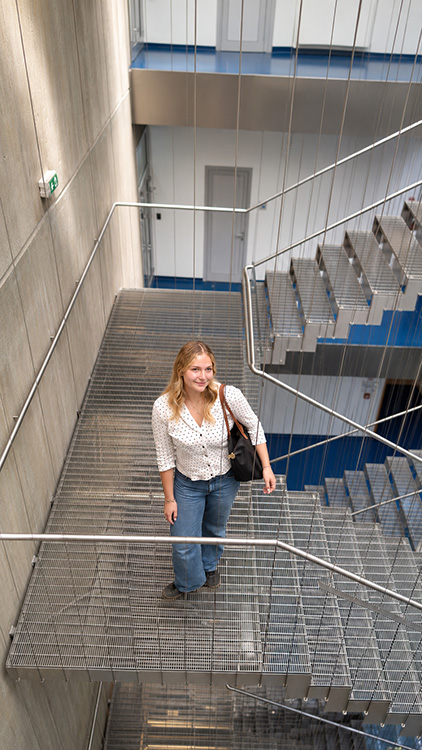
This summer, Boston University biology student Sasha Vorobyov crossed the Atlantic to spend seven weeks at the Institute of Molecular Genetics of the Czech Academy of Sciences (IMG) in Prague. She joined us through EUSA Academic Internship Experts, a not-for-profit international education organization that works with universities to arrange academically directed internships in several European cities, including Prague. Through a personalized placement process and ongoing support, the programme helps students gain professional experience, develop intercultural skills and connect their academic interests with the world of work.

For Sasha, that institution was the Institute of Molecular Genetics of the Czech Academy of Sciences–one of Central Europe’s leading biomedical research institutes. Home to more than 500 researchers, students and support staff representing dozens of nationalities, IMG is dedicated to advancing fundamental research in molecular biology, genetics and biomedicine while translating new knowledge into benefits for society. Alongside world-class research, IMG is committed to educating the next generation of internationally competitive scientists through its PhD School, international collaborations and hands-on training opportunities for scientists at every stage of their careers.
Hosted by Research Affairs Coordinator Ester Jarour, Sasha joined the Institute’s science communication and outreach activities, where she explored how scientific discoveries are communicated to different audiences while gaining first-hand experience of life in an international research environment. We asked Sasha to reflect on her summer in Prague, what surprised her most, and why she would encourage other Boston University students to follow in her footsteps.
Let’s start at the beginning. What made a biology student from Boston decide to spend the summer at the Institute of Molecular Genetics in Prague?
I wanted to spend my summer at IMG because I was looking for an opportunity to experience science from an international perspective. As a biology student from Boston, I’ve always been curious about how research institutions operate in other countries. IMG stood out because it’s an internationally recognized institute with researchers from around the world, and I knew it would be a great place to learn, grow, and step outside my comfort zone.
Before arriving, what were your expectations of IMG–and of the Czech Republic? Did anything surprise you once you got here?
Before coming to IMG, I imagined it would be a quiet place full of highly focused scientists, and I hoped everyone would be friendly and welcoming. Luckily, that turned out to be true–and even better than I expected. Everyone was incredibly kind and willing to answer my questions, which made me feel part of the team from the very beginning.
The biggest surprise for me was the work-life balance. In the U.S., there’s often a lot of pressure to always be working and staying busy. At IMG, I saw that people work really hard and produce amazing science, but they also value spending time with their families and having interests outside of work. It was refreshing to see that those two things can go hand in hand.
“It was exciting to know that my perspective as a student could actually help shape the institute’s communication strategy.”
Your studies focus on biology and healthcare, yet you chose an internship in science communication. What attracted you to this opportunity?

As a biology student, I have always imagined pursuing a career in healthcare. Recently, however, I started reading more scientific publications and news stories and realized how difficult they can be to understand without a background in biology. That made me curious about how communication, storytelling and even approaches from marketing can help make science more accessible.
When I saw this internship in science communication, it felt like the perfect opportunity to explore what a career in biology might look like beyond healthcare. I wanted to learn how scientific discoveries are translated into clear and engaging messages for different audiences, while still staying connected to the science itself.
During your internship you worked on social media, popularization of scientific publications, outreach activities and planning of the upcoming IMG PhD Conference. Which project did you enjoy the most, and why?
My favourite project was the social media analysis. I looked at how research institutions around the world communicate on social media and compared their approaches with IMG’s. I was then given the creative freedom to come up with my own ideas for how IMG’s social media could look and feel in the future. It was exciting to know that my perspective as a student could actually help shape the institute’s communication strategy.
IMG is home to researchers and PhD students from more than 20 countries. What was it like working in such an international environment?
Working at IMG was a fantastic experience because the institute truly feels international. Researchers and PhD students come from so many different countries that English naturally becomes the common language, making it easy to connect with people from all kinds of backgrounds.
Since Boston University is also very international, I was already used to being part of a multicultural community. That made IMG feel welcoming from day one and helped me settle in quickly. I think it also reduced the culture shock that some of my friends experienced during their internships abroad, because I immediately felt like I belonged.
“Scientific discoveries have the power to change lives, but they can only have an impact if people understand them.”
You’ve been volunteering with Breakthrough T1D for many years, helping children and families living with Type 1 diabetes. Did that experience influence the way you approached science communication at IMG?
Absolutely! My experience with Breakthrough T1D played a big role in why I chose this internship. For many years, I’ve volunteered with children who have just been diagnosed with Type 1 diabetes and their families. One of the most important parts of that role is helping children understand their condition in a way that isn’t frightening. Doctors often have to use complex medical terminology, which can feel overwhelming to a child, so I try to explain things in simple, reassuring language that they can relate to.
That experience made me realize how important science communication really is. Scientific discoveries have the power to change lives, but they can only have an impact if people understand them. At IMG, I saw how much effort goes into making research accessible to the public through news stories, social media and outreach activities. I think that’s incredibly important because it helps people understand why scientific research matters and how it can ultimately improve our lives.
Looking back, what new skills have you developed during these seven weeks that you think will be valuable in your future career?
Of course, I learned a lot about science communication and could talk about all the different projects I worked on. But if I had to choose one skill that will stay with me the longest, it would be time management and learning how to prioritize my work.
Ester taught me that not every task has the same level of urgency. I learned how to decide which emails need an immediate response, which assignments should come first, and how to organize my day in a way that keeps everything moving forward. Even something as simple as knowing when to take a lunch break helped me understand the importance of maintaining a productive routine.
I think time management is one of the most valuable professional skills anyone can develop, no matter what career they choose. It’s something I’ll definitely carry with me throughout my studies and into my future career.
Life wasn’t only about work. How did you enjoy living in Prague? Did you discover a favourite place, food or unforgettable experience?

Prague has been life-changing! It is honestly the most beautiful city I’ve ever seen, and every time I step outside my apartment, it brings a smile to my face. The city has such a unique atmosphere that it’s hard not to fall in love with it.
My favourite coffee spot is Choco Loves Coffee, and my go-to lunch place has been Kafka Hummus Café. (My recommendation? Order the French fries with ketchup and mayo–I promise, it’s life-changing!) My favourite place to wander is Čertovka, often called Prague’s “Little Venice.” I loved strolling along the canals, discovering little cafés and browsing the charming local shops.
What I love most about Prague is that every neighbourhood has its own personality and charm. There’s always something new to discover, whether it’s a hidden courtyard, a beautiful park or a cosy café. This city has truly captured my heart, and I know I’ll always leave a little piece of it here.
What do you think people in the United States would be surprised to learn about research–or everyday life–in the Czech Republic?
One of the biggest surprises for me was how incredibly clean Prague is. I think that’s something many Americans would notice right away. There is very little litter on the streets or in the metro stations, and I often saw city workers sweeping parks and even washing the sidewalks.
It might seem like a small detail, but it has a huge impact on how the city feels. Prague is already beautiful because of its architecture and history, but the care people take in maintaining it makes it an even more enjoyable place to live. It’s something I really came to appreciate during my time here.
“Working at IMG was a fantastic experience because the institute truly feels international. Researchers and PhD students come from so many different countries that English naturally becomes the common language, making it easy to connect with people from all kinds of backgrounds.”
If you had to describe IMG in just three words, what would they be?
COMMUNITY, CURIOSITY and EXCELLENCE. That’s what I’ll remember most about IMG. I immediately felt welcomed into a supportive community where people were always willing to help and share their knowledge. The curiosity of the researchers was inspiring, you could see how passionate they are about discovering new things. And everything, from the research to the way science is communicated, is done with a real commitment to excellence.
Finally, if another Boston University student asked whether they should apply for an internship at IMG, what would you tell them?
I would tell them to absolutely apply. This internship gave me so much clarity about what I want my future to look like and showed me just how many different career paths are possible with a background in biology.
Beyond the work itself, what made this experience so special was the people. Every day I had lunch with Ester, attended meetings and research presentations, and everyone I met was genuinely excited to introduce themselves and make me feel welcome. I never felt like “just the intern”–I felt like part of the community.
I was also given incredible opportunities that I never expected, such as attending BIOCEV’s 10th anniversary celebration, where I had the chance to meet scientific leaders and distinguished guests. Experiences like these gave me a much broader perspective on the research community and helped me build valuable connections.
Overall, my time at IMG has been one of the most rewarding experiences of my undergraduate studies, and it’s something I’ll never forget. I would recommend it to any Boston University student without hesitation.
Sasha’s internship may have lasted only seven weeks, but it demonstrates how valuable international exchange can be–not only for students discovering new career paths, but also for research institutions willing to welcome fresh perspectives.
At IMG, educating the next generation of scientists extends beyond the laboratory. Whether through research, international collaboration or science communication, we believe that learning is a two-way process. Sasha arrived in Prague hoping to gain new experience–but in the process, she also helped us see our own work through fresh eyes.
We thank Sasha for spending her summer with us and wish her every success at Boston University. We hope this will not be the last time our paths cross.
Mentor’s perspective
“Hosting Sasha was a wonderful experience–not only because she was bright, enthusiastic and eager to learn, but also because she brought a fresh perspective to our work. When you’ve been communicating science for years, it’s easy to assume you know what works. Having someone from a younger generation critically review our communication was incredibly valuable.”
“One of Sasha’s tasks was to evaluate our social media from the perspective of today’s university students. Her observations confirmed that if we want to engage future PhD candidates and younger audiences, we need to keep evolving–not only in the formats we use, but also in the way we tell scientific stories.”
“The internship became a genuine exchange of ideas. Sasha learned how science communication works within an international research institute, while we gained fresh insights into how our communication is perceived by the next generation. I would like to encourage others to invest time in mentoring international students. It requires commitment, but the experience enriches everyone involved.”
– Ester Jarour, Research Affairs Coordinator and Sasha´s Internship Mentor